
Best NFC Business Cards in 2026: A Practical Review
Honest comparison of NFC business cards by material, pricing, platform features, and total cost. No affiliate scores — just what matters.
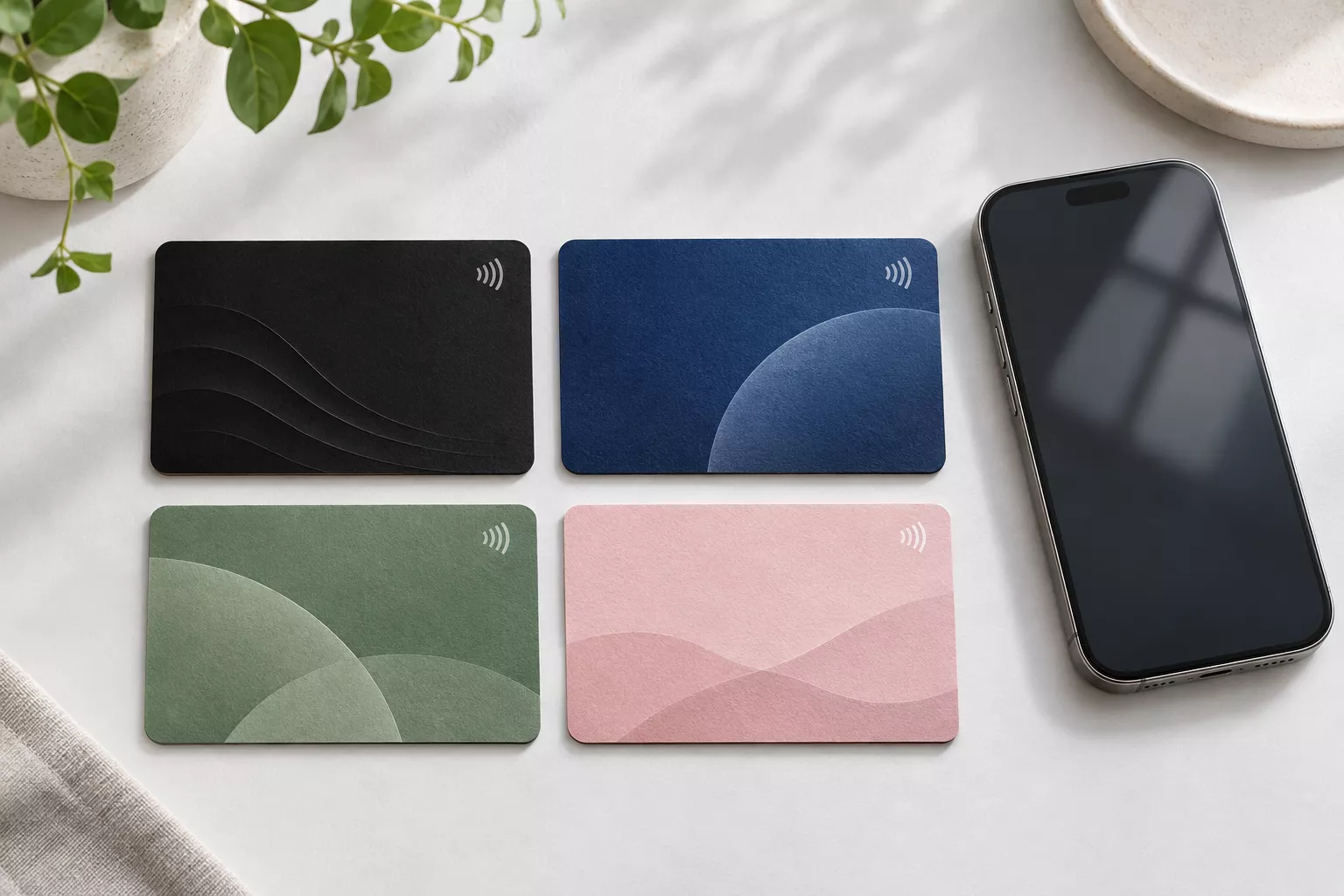
An NFC business card review should answer one question: what are you actually paying for? The card itself is one cost. The platform behind it — the digital profile, analytics, contact capture, and ongoing subscription — is often a bigger expense over time.
This guide compares NFC business cards across the criteria that affect daily use: materials, platform features, total cost of ownership, and the trade-offs each brand makes. There are no affiliate scores or sponsored rankings here — just a breakdown of what each option does well and where it falls short.
If you need background on how NFC technology works at the chip level, read NFC Business Cards: How the Technology Works. For a general overview of what NFC cards are and who they are for, see What Is an NFC Business Card?.
What to Evaluate in an NFC Business Card
Every NFC business card has two components: the physical card and the software platform. Reviewing only the card or only the platform gives you an incomplete picture.
The Physical Card
- Material — PVC, metal, wood, or recycled materials
- Finish — matte or gloss; affects fingerprint resistance and durability
- NFC chip — NTAG213 or NTAG215 are standard; both work for URL-based profiles
- QR code included — a printed QR code on the back provides a fallback for phones without NFC
- Custom design — whether you can add your logo, custom colors, or branding to the card
The Software Platform
- Digital profile — the web page the NFC chip opens
- Analytics — views, link clicks, geographic data
- Contact capture — whether visitors can send you their details
- Subscription model — one-time purchase vs. ongoing monthly or annual fees
- Profile ownership — what happens to your card if you stop paying or leave the platform
NFC Business Card Brands Compared
The following comparison reflects publicly available information as of mid-2025. Pricing and features change — verify details on each brand's website before purchasing.
Kobexa
Card: PVC with matte finish. NFC + QR code on every card. Available in Black, Blue, Green, and Pink.
Platform: Free digital profile with analytics, contact capture, 30+ themes, and no platform branding. No subscription required — the profile is free indefinitely.
Pricing model: One-time card purchase with free U.S. shipping. No monthly or annual software fees.
Best for: Individuals who want a full-featured free profile with an NFC card and no ongoing costs.
Trade-off: No team admin dashboard, no CRM integration, no wallet pass support. Designed for individual professionals, not enterprise teams.
Popl
Card: PVC and metal options. Custom printing available on higher tiers.
Platform: Free tier with basic profile. Paid plans add analytics, lead capture, CRM integrations, and team management. Popl's app holds a 4.8 rating on the App Store.
Pricing model: Card purchase plus optional subscription. Paid plans for individuals and teams. Popl does not always publish current pricing on its website — you may need to request a quote for teams.
Best for: Sales teams and event-heavy networkers who need lead capture and CRM routing.
Trade-off: Most useful features (analytics, lead capture) require a paid plan. The free tier is limited.
Blinq
Card: PVC, wood (Eco Wood), and metal options. QR code included.
Platform: Free plan with two profiles, QR sharing, and Apple Wallet integration. Paid plans add analytics, contact enrichment, and team features. Premium starts at $7.33/month billed annually.
Pricing model: Card purchase plus optional subscription. PVC from $19.99, wood from $29.99, metal from $49.99.
Best for: Individuals who want Apple Wallet support on the free tier and a choice of card materials.
Trade-off: Advanced analytics and branding customization are behind the paywall. Platform branding appears on the free plan.
V1CE
Card: PVC, bamboo, and metal options. Known for premium build quality and custom designs.
Platform: Lifetime software access included with card purchase — no monthly subscription. Profile editor, QR code, and basic analytics included.
Pricing model: One-time purchase. Cards start at approximately $78 for PVC and go higher for metal and custom designs.
Best for: People who want a premium physical card with no ongoing subscription and are willing to pay more upfront.
Trade-off: Higher upfront cost than most competitors. Fewer software features compared to subscription-based platforms with dedicated apps.
Mobilo
Card: PVC, wood, and metal options. Custom-printed cards available.
Platform: Mobile app with lead capture, CRM integration (Salesforce, HubSpot), and team admin features. Subscription plans start at $3/month or $48/user/year for teams.
Pricing model: Card purchase (PVC from $19.99, custom from $39, metal from $139) plus subscription for advanced features.
Best for: Sales teams that need CRM-connected lead capture and multi-user management.
Trade-off: The subscription adds up. A $20 card with a $7/month plan costs $104 in the first year. Over three years, that is $272 — far more than the card itself.
Linq
Card: PVC and metal options.
Platform: Strong analytics and data features. Originally focused on individual networking. Note: Linq's parent company pivoted toward AI messaging in 2026, which may affect the product's direction and long-term support.
Pricing model: Card purchase with free tier and optional paid plans.
Best for: Analytics-focused users who want detailed engagement data.
Trade-off: The platform's strategic direction is uncertain, which is a risk for long-term URL permanence.
Cost Comparison Table
This table shows the approximate total cost for one individual user over the first year, including card purchase and any required or typical subscription. Prices are rounded estimates based on publicly available information and may vary.
| Brand | Card Cost (PVC) | Annual Software Cost | First-Year Total | Subscription Required? |
|---|---|---|---|---|
| Kobexa | ~$25 | $0 | ~$25 | No — free profile forever |
| Popl | ~$20–$30 | $0–$84 (varies by plan) | $20–$114 | No for basic; yes for analytics/CRM |
| Blinq | ~$20 | $0–$88 | $20–$108 | No for basic; yes for premium features |
| V1CE | ~$78+ | $0 (lifetime) | ~$78+ | No — included with purchase |
| Mobilo | ~$20 | $36–$84 | $56–$104 | Yes for most features |
| Linq | ~$20–$30 | $0–$60+ | $20–$90+ | No for basic; yes for advanced |
The pattern: brands with low card prices often make it up through subscriptions. Brands with higher card prices tend to include software at no ongoing cost. The cheapest card is not always the cheapest solution.
What "Free Profile" Actually Means Per Platform
"Free" varies significantly. Here is what each brand includes and excludes on their free tier:
| Feature | Kobexa | Popl | Blinq | V1CE | Mobilo |
|---|---|---|---|---|---|
| Profile with no platform branding | Yes | No | No | Yes (paid card) | No |
| Analytics | Yes | Limited | Limited | Basic (included) | Limited |
| Contact capture | Yes | Paid | Paid | Varies | Paid |
| QR code sharing | Yes | Yes | Yes | Yes | Yes |
| Number of profiles | 1 | 1 | 2 | 1 per card | 1 |
| Theme customization | 30+ themes | Templates | Templates | Templates | Templates |
If you plan to use the free tier long-term, check whether the features you need — especially analytics and contact capture — are included or gated.
Material and Build Quality
The card you hold in your hand matters for first impressions. Here is how materials compare in practice:
| Material | Durability | Feel | Fingerprint Resistance | Price Range | Signal Reliability |
|---|---|---|---|---|---|
| PVC (matte) | High | Smooth, professional | Good — matte hides prints | $15–$30 | Excellent |
| PVC (gloss) | High | Slick, shiny | Poor — shows every touch | $15–$30 | Excellent |
| Wood / Bamboo | Moderate | Warm, distinctive | Good — grain masks prints | $25–$60 | Good |
| Metal (aluminum) | Very high | Heavy, premium | Moderate | $50–$140 | Good — needs antenna cutout |
| Metal (steel) | Very high | Very heavy, substantial | Moderate | $70–$140+ | Good — needs antenna cutout |
A few practical notes:
PVC matte is the most reliable all-around option. It scans consistently, resists fingerprints, fits in any wallet, and costs the least. This is what credit cards and hotel keys use for a reason — the format is proven.
Metal cards make a strong impression when you hand one over. They are noticeably heavier (20–30g vs. 5–6g for PVC), which some people associate with quality. The trade-off is cost and the engineering required to keep the NFC antenna functional inside a metal body.
Wood and bamboo stand out visually. They work well for brands that emphasize sustainability or natural aesthetics. They are less durable than PVC in humid environments or if carried loose in a bag.
The Subscription Trap: Total Cost of Ownership
The most important number in an NFC business card review is not the card price — it is the total cost over 1–3 years.
A $20 card with a $7/month subscription costs $104 in year one and $264 over three years. A $25 card with no subscription costs $25 total, no matter how long you use it.
Before purchasing, ask these questions:
- Does the card work without a subscription? On some platforms, canceling your subscription deactivates the URL the chip points to. The card becomes a piece of plastic.
- What features are free vs. paid? If analytics and contact capture require a subscription, the "free" card is not free to use in any meaningful way.
- What is the three-year cost? Multiply the monthly fee by 36 and add the card price. Compare that total across brands.
- Can you switch platforms without replacing the card? Some cards are locked to one platform. Others can be reprogrammed with an NFC writing app to point to a new URL.
Limitations and Honest Trade-Offs
No NFC card solves every networking scenario. NFC only works in person, within a few centimeters. For remote sharing — email, social media, messaging — you need a link or QR code. The NFC card is a complement to your digital profile, not a replacement for it.
Premium materials do not mean better technology. A $140 metal card and a $25 PVC card use the same NTAG chip and serve the same URL. The technology is identical — the difference is aesthetics and perceived status.
Subscription-based platforms can change terms. A platform could raise prices, remove free features, or shut down. If your card's URL depends on that platform, your card stops working. Platforms with one-time pricing and no subscription remove this risk.
"Lifetime" software claims need scrutiny. "Lifetime access" means for the lifetime of the company, not necessarily your lifetime. If the company closes or pivots, the service may end. Check how long the company has been operating and whether they have funding or revenue stability.
QR fallback quality varies. Some brands print a high-contrast QR code on the back of every card. Others make QR an afterthought — small, low-contrast, or missing entirely. A card without a QR code fails for any recipient whose phone does not support NFC.
How to Get Started with Kobexa
- Create your free digital profile at kobexa.com/signup — add your details, links, photo, and choose from 30+ themes.
- Order your NFC card from the shop — PVC, matte finish, NFC + QR code included on every card. Black, Blue, Green, and Pink. Free U.S. shipping.
- Test the tap on at least one iPhone and one Android phone.
- Share your profile link digitally as well — email signature, social bios, presentations.
- Check analytics from your dashboard to see who is viewing your card and which links they tap.
No subscription. No branding on your profile. No feature gating on the free plan.
Frequently Asked Questions
Which NFC business card brand is the best?
There is no single best brand — it depends on your priorities. Kobexa is the strongest option for individuals who want a free profile with analytics and no subscription. Popl and Mobilo lead for sales teams that need CRM integrations. V1CE offers the most premium physical card with no ongoing fees. Blinq has the widest material selection at moderate pricing.
Are metal NFC business cards worth the price?
Metal cards create a memorable first impression and last longer than any other material. They are worth it if the impression matters to your brand and you are comfortable with the price ($50–$140). Functionally, they do the same thing as a PVC card — the NFC chip inside is identical. If budget is a factor, PVC delivers the same technology at a fraction of the cost.
Can I use an NFC business card without a subscription?
Yes, on platforms that include free profile software. Kobexa and V1CE both offer profiles without ongoing fees. On subscription-based platforms like Mobilo or Popl's advanced tiers, canceling the subscription may disable the profile URL — which means the card stops working. Always confirm this before buying.
How long does an NFC business card last?
The NFC chip is rated for 100,000+ taps and 10+ years of data retention. The card's physical lifespan depends on the material: PVC cards last years with normal wallet wear; metal cards last longer. The practical limit is usually the platform — if the company behind the card goes offline, the URL stops resolving regardless of chip condition.
Do all NFC business cards include a QR code?
No. Some brands sell NFC-only cards without a printed QR code. This is a problem for compatibility — not every phone has NFC enabled, and older iPhones require manual NFC scanning. A QR code on the back guarantees every recipient can access your profile. Kobexa includes a QR code on every card.
Can I switch my NFC business card to a different platform?
It depends on the card. Some NFC cards are write-locked to the vendor's URL and cannot be reprogrammed. Others use writable NTAG chips that you can reprogram with a free NFC writing app (like NFC Tools) to point to a new URL. Before purchasing, check whether the card can be rewritten or if it is permanently locked to the vendor's platform.
Is one NFC card enough, or do I need multiples?
One card is enough for most individuals. Unlike paper cards, you are not giving the card away — you tap it and keep it. Some people order two: one for a wallet and one for a desk or bag. For teams, each person needs their own card linked to their own profile.
The best NFC business card is the one that works reliably, links to a profile you control, and does not charge you monthly for the privilege of using a card you already bought.
Ready to upgrade your networking?
Get your NFC business card from Kobexa
Tap to share your profile instantly — no app required. Pair it with a QR fallback and keep your details updatable forever.
Shop Now