
Digital Business Card vs. Paper Business Card: The Full Comparison
Compare digital and paper business cards by cost, retention, analytics, and environmental impact. Data-backed breakdown with honest trade-offs.
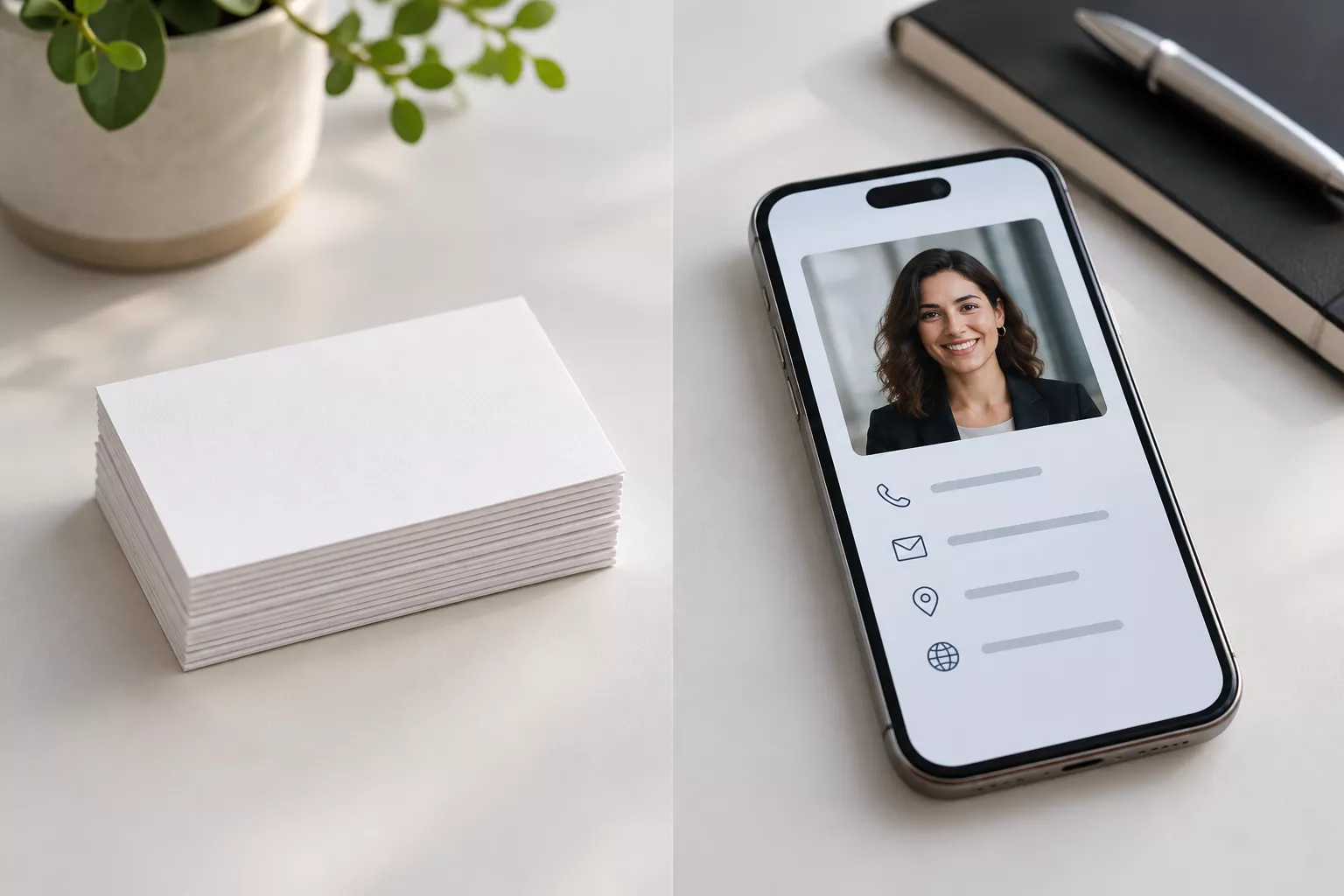
A paperless business card is a digital profile page that replaces the information traditionally printed on a paper card — name, title, phone, email — with a shareable URL that holds all of that plus social links, a photo, a bio, and analytics. You share it via a link, QR code, or NFC tap instead of handing over a printed card.
This guide compares digital and paper business cards across the dimensions that matter: cost, information capacity, retention, analytics, environmental impact, and the situations where each format still makes sense. The goal is not to argue that one is universally better — it is to give you the data to choose the right format for how you actually network.
The Core Difference
A paper business card is a static object. Once printed, the information on it cannot change. If your phone number, job title, or company changes, every card you have already distributed is outdated and every remaining card in your desk drawer needs to be recycled.
A digital business card is a live web page. The URL stays the same, but the content behind it — your name, title, links, photo, bio — can be updated at any time from a dashboard. Anyone who saved the link sees the current version the next time they open it.
This distinction drives every other difference in the comparison.
Side-by-Side Comparison
| Paper Business Card | Digital Business Card | |
|---|---|---|
| Information | Name, title, phone, email, website, logo | Unlimited — all contact details, social links, bio, photo, documents, booking links |
| Updatable | No — reprint required | Yes — edit anytime from a dashboard |
| Cost per contact | $0.04–$0.20 per card (varies by quantity and stock) | $0 per share (free digital profile) |
| Sharing method | Hand it over in person | Link, QR code, NFC tap, email, text, social media |
| Recipient action | Manually type details into phone or keep the card | Tap a link and save — details are already digital |
| Analytics | None | Views, link clicks, visitor locations, timestamps |
| Contact capture | One-way — you give, they take | Two-way — visitors can send you their details |
| Retention | 88% discarded within one week | Link stays accessible indefinitely |
| Environmental impact | Paper, ink, shipping per batch | Zero waste (digital) or one reusable card (NFC) |
| Reprint cycle | Every 3–18 months when details change | Never — update the profile instead |
Cost Over Time
Paper cards seem cheap per unit. The real cost is cumulative: initial printing, reprints when details change, rush orders before events, and the design time for each revision.
Paper Card Costs
- 250 standard cards: $20–$50 depending on paper stock and finish
- Premium cards (thick stock, foil, embossing): $0.20–$0.50+ per card
- Reprint frequency: every 3–18 months depending on role changes and networking volume
- Annual cost for active networkers: $120–$275 per year including reprints
Every reprint restarts the cost cycle. A promotion, a new phone number, or a company rebrand triggers a full reorder — plus wasting any remaining old cards.
Digital Card Costs
- Digital profile: $0 on platforms like Kobexa that offer free plans with no branding or feature limits
- Optional NFC card: one-time purchase (e.g., Kobexa NFC cards from the shop with free U.S. shipping)
- Annual cost: $0 for digital-only; one-time purchase for NFC
The cost comparison is not close over a three-year horizon. Paper costs accumulate with every reprint. A digital profile is free to maintain, and an NFC card is a one-time expense.
Three-Year Cost Example
| Scenario | Paper Cards | Digital + NFC Card |
|---|---|---|
| Year 1 | $50 (initial print) + $50 (reprint after title change) = $100 | $25 (NFC card) + $0 (profile) = $25 |
| Year 2 | $50 (reprint for new phone number) = $50 | $0 |
| Year 3 | $50 (reprint for company rebrand) = $50 | $0 |
| Total | $200 | $25 |
This assumes moderate changes — one reprint per year. Professionals who change roles or companies more frequently spend more on paper.
Retention and Follow-Up
The most cited statistic in the digital business card space is that 88% of paper business cards are thrown away within one week. The exact number will vary by study, but the pattern is consistent: most paper cards do not survive the trip home from an event.
The reason is friction. A paper card requires the recipient to:
- Keep the card physically
- Find it later when they want to follow up
- Manually type the contact details into their phone
- Discard the card afterward
Most people skip step 3. The card sits in a pocket, then a desk, then the trash.
A digital business card removes every friction point. The recipient taps a link or scans a QR code, and your profile is immediately accessible on their phone. If they tap the save-to-contacts button, your details are in their phone's address book within seconds. The link stays in their browser history even if they do not save it.
Digital cards generate 30% higher follow-up rates than paper cards. The reason is straightforward: the contact details are already digital, so following up is as simple as tapping your phone number or email link.
Analytics: Knowing What Happens After You Share
Paper cards give you zero data. You hand someone a card and hope they contact you. You have no way to know if they looked at it, threw it away, or passed it to someone else.
A digital business card with analytics shows you:
- Profile views — how many people opened your card
- Link clicks — which links (phone, email, LinkedIn, website) people actually tap
- Geographic data — which cities and countries your viewers are from
- Activity timeline — when each view and click happened
This data changes how you follow up. If someone viewed your profile three times and clicked your LinkedIn link, that is a warm lead worth reaching out to. If you shared 50 cards at an event and only 8 people opened your profile, that tells you something about the event's quality or your sharing method.
Paper cards give you a stack of names. Digital cards give you signals.
Environmental Impact
The environmental cost of paper business cards is not trivial at scale:
- 100 billion business cards are printed worldwide each year
- Production requires approximately 7 million trees annually
- 88% of those cards end up as waste within one week
- Each reprint cycle adds paper, ink, packaging, and shipping emissions
A digital business card eliminates the paper and shipping entirely. The environmental cost is limited to the energy used to host the profile page — negligible compared to physical production and distribution.
If you use an NFC card, there is a one-time manufacturing cost (PVC, chip, antenna). But one NFC card replaces years of print runs. A single card used for three years replaces thousands of paper cards that would have been printed, distributed, and discarded during that same period.
This is not a reason to switch on its own. But if your company tracks sustainability metrics or your personal brand values environmental responsibility, the difference is measurable.
When Paper Business Cards Still Make Sense
Digital cards are better for most scenarios, but paper cards are not obsolete in every context:
Formal and traditional industries. Law firms, government agencies, diplomatic settings, and some financial institutions still expect a physical card exchange as part of professional etiquette. In these contexts, not having a paper card can read as unprepared.
Trade shows with badge scanning. Some trade shows use badge scanners or business card drop boxes for lead collection. A digital card does not fit into a fishbowl raffle. You may need paper cards specifically for these legacy formats.
Branding as a physical artifact. A beautifully designed, heavy-stock paper card with letterpress or foil stamping can make a strong impression as a design object. Some creative professionals use the card itself as a portfolio piece — a tactile demonstration of their design sensibility.
Situations with no phone. If the recipient does not have their phone handy — less common now but not impossible — a paper card is the only option.
Cost sensitivity for very small volumes. If you network once or twice a year and your details rarely change, a $20 box of 250 cards is a simple, cheap solution.
In these cases, paper cards work fine. The question is whether they work fine as your primary networking tool or as a backup for specific situations.
When Digital Cards Are the Clear Choice
You network frequently. If you attend events, meet clients, or make professional introductions regularly, a digital card scales without additional cost.
Your information changes. New title, new company, new phone number — any change kills the value of printed cards. A digital profile handles changes instantly.
You network remotely. Paper cards do not work in email, LinkedIn messages, Zoom calls, or social media bios. A digital card works in every digital channel.
You want to measure results. Analytics tell you whether your networking generates engagement or just polite smiles.
You work in tech, startups, creative industries, or sales. These fields expect digital fluency. Sharing a digital card signals you are current, not stuck in 2010.
You care about sustainability. Eliminating recurring print runs removes paper waste from your networking workflow entirely.
The Hybrid Approach: Best of Both
You do not have to choose one or the other. The most practical setup combines both formats:
- A digital business card as your primary sharing tool — works via link, QR code, email, and social media. Create one for free.
- An NFC card with a QR code for in-person meetings — satisfies the physical exchange expectation while delivering a digital experience. The recipient gets your full profile on their phone, not a paper card they might discard. See NFC cards in the shop.
- A small stock of paper cards for formal situations or legacy systems that require them.
This covers every scenario: remote sharing, in-person taps, and the occasional formal exchange.
For details on setting up the NFC + QR side, read QR Code Business Cards: How They Work and What Is an NFC Business Card?.
Limitations of Going Fully Paperless
Going 100% paperless works for most professionals, but there are real constraints:
Internet dependency. A digital profile is a web page. If the recipient has no cell service or Wi-Fi at the moment of scanning, the page will not load until connectivity returns. The URL is still captured and will open later — but the immediate impression depends on internet access.
Recipient awareness. Not everyone is familiar with scanning QR codes or tapping NFC cards. While 97% of smartphones support native QR scanning, some people are simply not in the habit. A brief explanation — "point your camera at this" or "hold your phone here" — usually resolves it.
Cultural expectations. In some business cultures, particularly in East Asia, the physical exchange of business cards is a ritual with specific etiquette. A digital card may not be a culturally appropriate substitute in these contexts, though it can supplement the exchange.
Platform risk. Your digital card lives on a URL controlled by the platform you chose. If the platform shuts down or changes its free plan, your card could stop working. Choose a platform with a stable track record.
How to Get Started
- Create your free digital business card at kobexa.com/signup — takes under a minute.
- Add your details — name, title, bio, photo, links, and contact info.
- Choose a theme — 30+ options with customizable accent colors and dark mode.
- Share your card — copy the link, download your QR code, or paste the URL in your email signature and social bios.
- Optional: order an NFC card from the shop for in-person sharing — includes NFC + QR, free U.S. shipping.
Your digital profile is free with analytics, contact capture, and no platform branding.
Frequently Asked Questions
Are paper business cards dead?
No. Paper cards still have a place in formal settings, certain industries, and legacy event formats. But they are no longer the default for most professional networking. 37% of businesses have adopted digital cards, and paper card printing volumes dropped significantly during the pandemic and have not fully recovered. The trend is toward digital, but paper is not gone.
How much do paper business cards really cost per year?
For active networkers, the annual cost is typically $120–$275 including initial orders and reprints. Infrequent networkers might spend $20–$50 per year. The main cost driver is reprint frequency — every time your details change, you pay for a new batch and waste the old one.
Can I use a digital business card at a formal networking event?
Yes. An NFC card gives you a physical object to hand over (or tap), which satisfies the expectation of a tangible exchange. The recipient gets a digital profile on their phone instead of a paper card in their pocket. For very traditional settings, carry a few paper cards as a backup.
Do digital business cards actually get better follow-up rates?
Data from industry surveys suggests 30% higher follow-up rates for digital cards compared to paper. The mechanism is simple: a digital card puts your contact details in the recipient's phone immediately, removing the friction of manual data entry that causes most paper cards to be discarded.
What is the environmental impact of switching from paper to digital?
Paper business card production uses approximately 7 million trees per year globally for an estimated 100 billion cards. 88% are discarded within a week. Switching one person to digital eliminates hundreds or thousands of printed cards over a career. At the organizational level, a 10,000-person company switching to digital saves an estimated 125 trees, 50,000 gallons of water, and 7,500 lbs of carbon annually.
Is an NFC card better than paper if it is also physical?
An NFC card is physical, but it functions differently. You do not give it away — you tap it, and the recipient gets your digital profile on their phone. One card serves unlimited contacts. It never goes stale because the profile behind it is editable. Paper cards are single-use, static, and consumed on each exchange. An NFC card is reusable infrastructure.
Can I switch from paper to digital gradually?
Yes. Start by creating a free digital business card and sharing the link in your email signature and social bios. Keep your paper cards for in-person events. As you get comfortable with QR sharing and see the analytics data, you will naturally shift more of your networking to digital. Add an NFC card when you are ready to replace paper at in-person events entirely.
Paper business cards served professionals for decades. Digital business cards do the same job with less cost, less waste, better data, and no reprints. The shift is not about abandoning paper — it is about choosing the format that actually gets your contact details saved, used, and followed up on.
Ready to upgrade your networking?
Get your NFC business card from Kobexa
Tap to share your profile instantly — no app required. Pair it with a QR fallback and keep your details updatable forever.
Shop Now